Classification of Terracotta Panel Curtain Wall Product Installation Methods
Since standards for terracotta panels have varying requirements for product model specifications across different standards, which cannot be unified, this article introduces them based on the thickness of the panels.
1. For panels with a total thickness of 18mm, these typically employ a back-groove hanging method. Their cross-sectional shape is as shown in the diagram below:
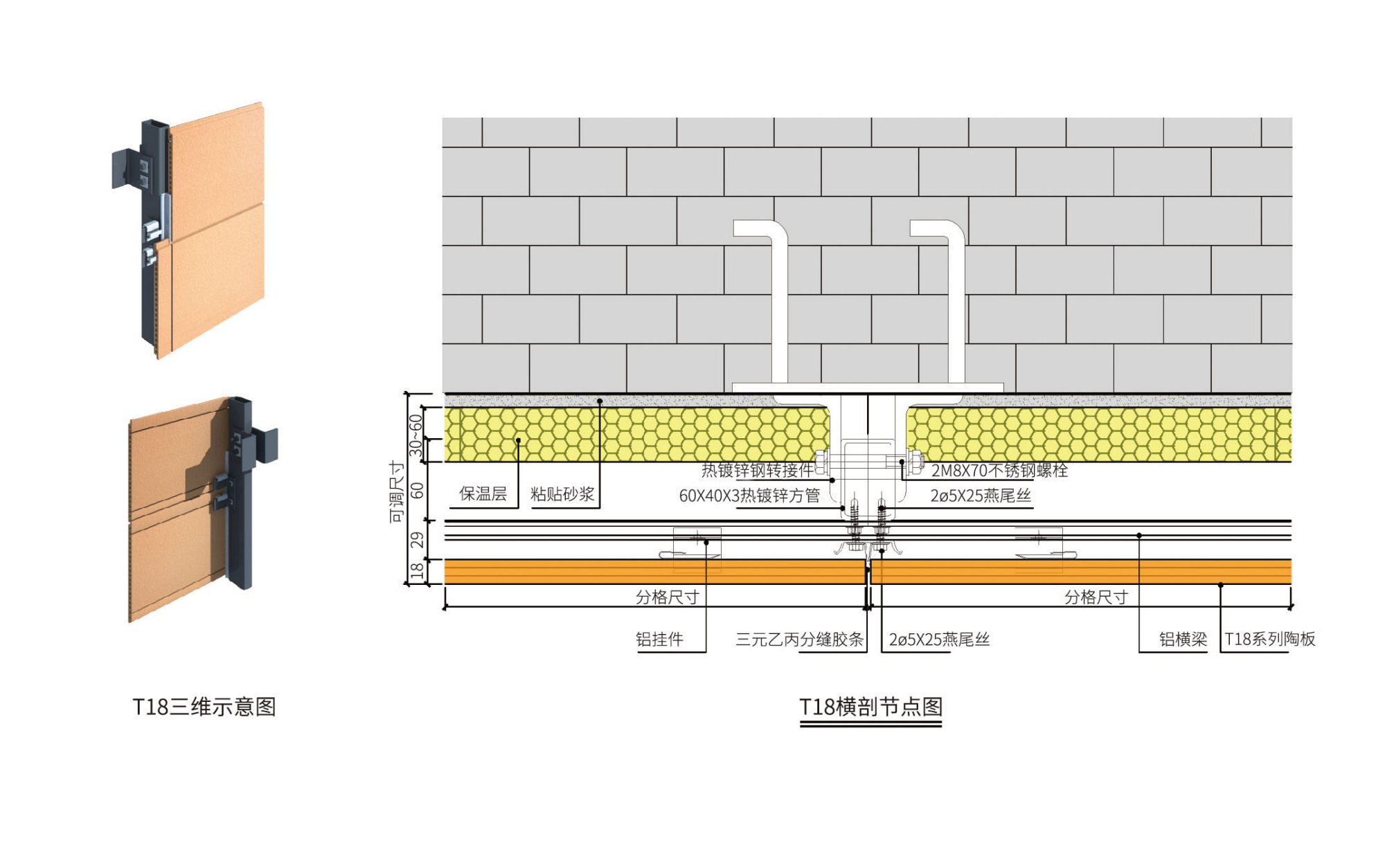
The dimensions of 18mm terracotta panels also vary among manufacturers, and the center-to-center distance between their two T-slots during installation is not uniform, primarily being either 96mm or 66 (67) mm. This issue must be considered when selecting hanging components and determining the position of horizontal supports.
The unit weight of 18mm thick terracotta panels is approximately 32kg/㎡, with a breaking strength of 2100N (average value) (GB/T 27972-2011).
2. For ceramic panels with a total thickness of 19mm, since national standards require specific thickness specifications for hanging parts on panels exceeding 18mm, this requirement is difficult to achieve within the 19mm space. As a result, this specification is rarely seen in the market and will not be further discussed here.
The total thickness of the terracotta panel is 22mm (including 21mm and 22mm). Such panels typically adopt a top-and-bottom interlocking mounting method, with their cross-sectional shape shown in the following diagram:
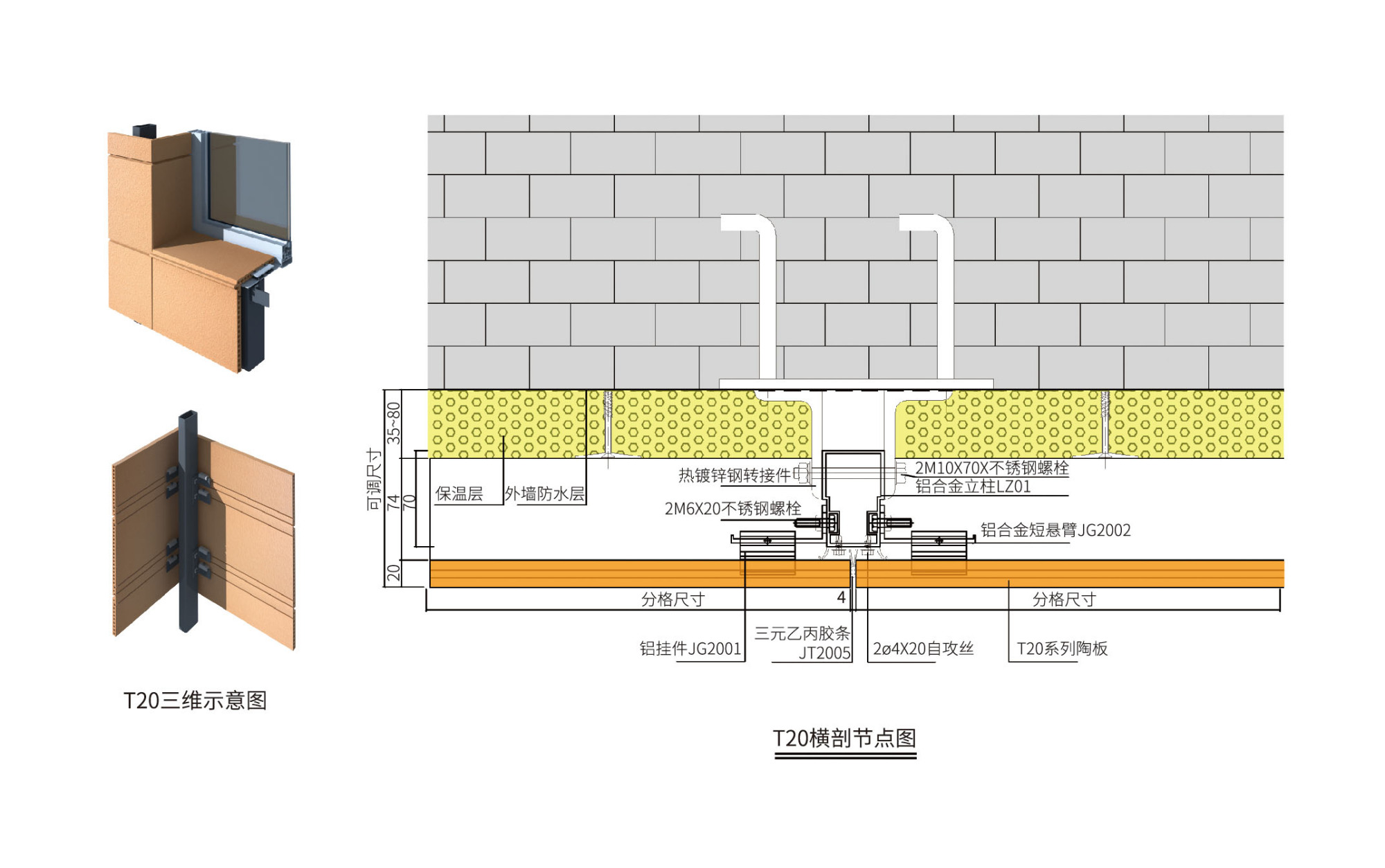
The dimensions in the above diagram also vary by manufacturer. When selecting the hooks, consider the contact length of the upper hooks to ensure secure mounting.
The design of the connection structure between the pendant and the ceramic panel shall comply with the following provisions:
The upper part adopts a socket-type hanger, and when the weight of the ceramic panel is borne by the lower hanger, measures should be taken to prevent the ceramic panel from breaking and falling. There should be no gap in the vertical contact area between the load-bearing hanger and the hanging groove of the ceramic panel.
3. Ceramic panels with a total thickness of 30mm
Such ceramic panels generally adopt top and bottom socket-type hanging, and their cross-sectional shape is as shown below:
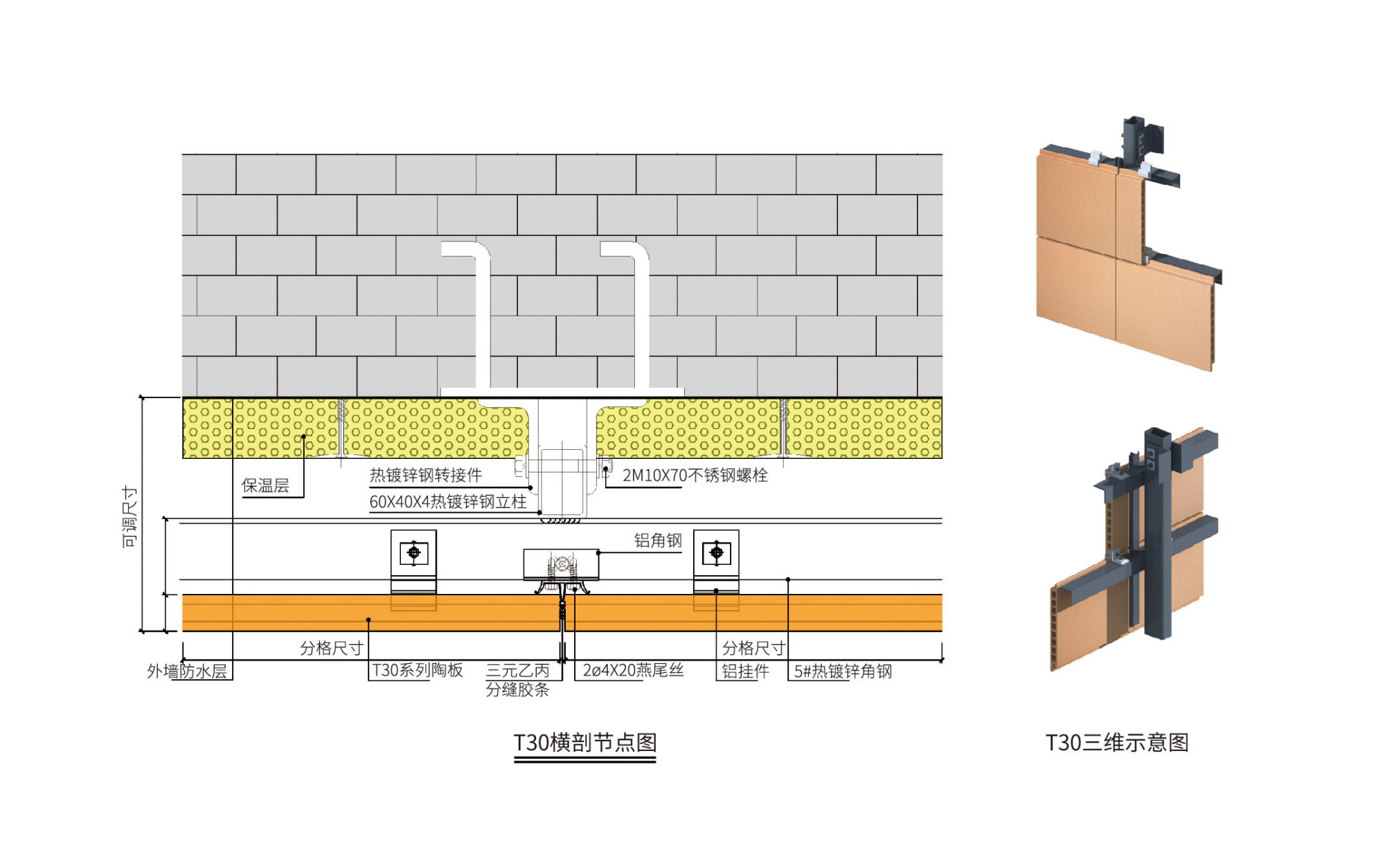
The forming process of ceramic panels is extrusion molding, with their width determined by the mold and their length adjusted by cutting equipment according to instructions. That is, the panel width is set to a single value, while the panel length is configured based on project requirements.
Generally, the module height (ceramic panel decorative surface width plus horizontal joint width) for ceramic panel curtain walls is: 300mm, 400mm, 450mm, 500mm, and 600mm. Other sizes can be customized by producing specific molds. Many manufacturers use the total width of the ceramic panels as the width value when calculating the sales area, which results in the calculated usage of ceramic panels being slightly larger than the visible area of the curtain wall.
The center spacing of vertical curtain wall mullions is generally below 1.2m, and the corresponding length of ceramic panels is also within 1.2m.
(Source:Shaohua Ceramic Panel Manufacturer)
Jiangxi Shaohua Ceramics Co., Ltd. adheres to the principles of environmental protection, ecology, and humanity. The company specializes in the development, research, and innovation of clay-based architectural products, with main products including terra-cotta curtain walls, ceramic bricks, terra-cotta rods, terra-cotta louvers, and other new exterior wall decorative building materials.
 HOME
 PRODUCT
 CASE
 CONTACT